
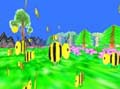
 Dan Sandin, co-director of the Electronic Visualization Laboratory (EVL) and a full professor of art in the School of Art and Design at the University of Illinois at Chicago, is bringing a shared, persistent CAVE virtual-reality experience to the Ars Electronica Center. EVL: Alive on the Grid will be presented from September 1, 2001 in the context of the Ars Electronica Festival.
EVL: Alive on the Grid is comprised of many virtual worlds featuring varying elements of sound, interactivity and navigation. All of the works will be displayed in a CAVE, a four-wall, theatre-style virtual reality environment in the Ars Electronica Center, with additional sites participating over the Grid. On-site visitors will access the worlds through a virtual atrium, where they will encounter and interact with the networked visitors.
A common feature of the network-enabled worlds is persistence, which means the environments do not end once the visitors leave the CAVE. Rather, the worlds continue to accrue life through the traces left by past visitors for future visitors to enjoy. Enabled by the Grid--collections of networks, computers and virtual reality displays that span the globe--users of this unique media can “virtually” interact with one another, and the models contained within each piece.
Festival visitors will be able to select their virtual representation, or avatar, complete with a photorealistic 3D face, and manipulate it in realtime using lightweight head and hand trackers. Each visitor’s avatar will join other networked participants to explore these VR environments. Visitors, communicating and interacting through their avatars, will have the ability to create and alter the virtual worlds they visit, leaving “ghosts” of themselves for others to view. Whether there are people in the Ars Electronica CAVE or not, the VR environment will continues to grow and collect information from remote participants on the Grid.
The Electronic Visualization Laboratory invented the CAVE in 1991, and brought it to the Ars Electronica Center when it opened in 1996. Since then, EVL has concentrated on the development and deployment of networked virtual reality, that is, VR worlds that distantly located people can view and change in real time.
Dan Sandin, einer der Direktoren des Electronic Visualization Laboratory (EVL) und Professor an der School of Art and Design at the University of Illinois at Chicago, bringt ein nicht-vergängliches VR-Erlebnis in den CAVE des Ars Electronica Center. Präsentiert wird EVL: Alive on the Grid im Rahmen des Ars Electronica Festivals ab 1. September 2001.
EVL: Alive on the Grid ist ein nicht-vergängliches VR-Erlebnis, das sich aus zahlreichen virtuellen Welten zusammen setzt. Nicht vergänglich meint, dass dieses virtuelle Environment aktiv bestehen bleibt, auch nachdem die TeilnehmerInnen den CAVE verlassen haben. Diese Welten existieren vernetzt in vielen CAVEs, VR-Environments und im Web. CAVE-BesucherInnen auf der ganzen Welt können diese gemeinsamen Räume betreten, dort interagieren, miteinander sprechen, sowie die virtuellen Welten ergänzen und verändern.

