
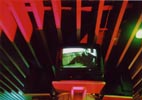
 'One never sees a new art,' someone once wrote about new media. 'A 'new art,' may be recognized by the fact that it is not recognized.' And so the story goes with the Ars Electronica Festival, an annual celebration of all things new in the field of art and technology, some easy to recognize and others not so. Read Alex Galloway's 'Rhizome' commentary on Ars Electronica 2001.
Ars Electronica '01
Alex Galloway, September 7
For twenty years Ars Electronica has stood as a global champion of new media art. With its headquarters in Austria the organization attracts a international audience through its exhibition center, its prestigeous prize (the Prix Ars Electronica) and annual festival which concluded Thursday.
Once again the Ars Electronica Festival created that most coveted of things, the temporary autonomous zone where people interact and new ideas are sparked, where work is developed and exhibited to the public. The Europeans seem to have a particular knack for this. Recent criticism of Ars, particularly their unusual selections for the 'net' portion of the Prix Ars Electronica, had left me skeptical. Yet detractors be damned, this is a good and important festival.
Each year Ars Electronica creates a specific zone within the festival devoted to laboratory experiments, works in progress, and incidental happenings. This year that zone was called the 'electrolobby,' a sprawling array of desks set up in the basement of the main auditorium. The electrolobby focuses most closely on youth culture such as gaming, clubbing, computers, and so on. TNC Network from France were responsible for putting it all together. A small collective within the electrolobby spun off to tackle the 'game jam.' The challenge of the jam was to create a computer game from start to finish in just four days. Animators, coders and other cohorts collaborated on the project for a few frenzied days and the result was superlative, a fully functional computer game (based in Flash) that would blow away half the junk seen in today's arcades. Other interesting electrolobby participants included the graphic design web zine Kaliber10000, and the Slashdot spin off site Everything which is an innovative technology for managing website content.
This year's winner of the Prix Ars Electronica for Net.Excellence was PrayStation.com, the unique online portfolio created and maintained by Flash guru Joshua Davis. PrayStation.com is organized in calendar format with new works uploaded to coincide with particular days of the year. Sometimes whole weeks are empty, sometimes many days in a row contain new work. Unlike Davis's main other creative outlet, the website Once- Upon-A-Forest which features completed artworks, PrayStation is meant to show quick ideas, sketches, and other works in progress. While he works in Flash, a normally closed source animation medium, Davis makes a point of giving away all PrayStation source code for free via the website. This amounts to what he calls a distance learning system, in which common-minded coders may use the site as a hub to read new code, learn, and exchange ideas.
In the main town square an unusual artwork was installed. A paintball gun fires paint balls from a tourret in random intervals at a large billboard. Over the course of a few days, the billboard grows to resemble a formalist artwork, perhaps from the Abstract Expressionist style. The top of the billboard reads 'If you don't think this is art, call 0800-123 456.' Then, if someone reaches for their cell phone and calls the number, a computer receives the call and causes the paintball gun to fire another shot at the billboard. Ha! This is public art for the cell phone-savvy masses.
Another piece which I arrived too late (oops!) to experience--but for which several people gave me rave reviews--was Golan Levin's cell phone artwork called Dialtones: A Telesymphony. The audience arrives at the auditorium and registers if they have a cellphone with them. Then, at a prearranged time, Levin sends calls to all the different phones in the auditorium, prompting them to ring in different patterns and frequencies.
The 'Ridin' A Train' performance, normally a highlight of the festival, was cancelled and replaced this year with Container Park, a massive site-specific installation that took place in the city's shipyard off the Danube river. Inside a maze of shipping containers piled thirty feet high, two forklifts drove in a slow, choreographed pattern carrying lights and sound installations in their front loaders. At times the forklifts appeared to stalk the audience, and at times they appeared more carefree, wandering off into the shipping yard. The Container Park party was capped off with a performance by Senior Coconut and his eight piece salsa band. What made this band special however was that they played only Kraftwerk covers. You had to hear it to believe it.
Having said all this, another highlight must be reported, a rainbow I saw over the Linz skyline early Wednesday evening. Like the artwork in the festival, this was a rainbow to rival all comers: a not only did the arc stretch completely from one horizon to another but it was a doubledecker with both a upper and lower arc, plus ripples of color receding into the center. ('Damn, now THAT'S a rainbow,' I thought to myself.) And in my simple brain, of course, this rainbow must represent the halo of creativity and insight that the digital art scene sparks within the receding dot-com storm. Keep it up kids, another excellent Ars festival for the history books.
'Man sieht nie eine neue Kunst', schrieb einmal jemand über Neue Medien. 'Eine 'neue Kunst' erkennt man daran, dass sie nicht anerkannt wird.' Und genau das gilt auch für das Festival Ars Electronica: ein Fest für alles, was neu ist auf dem Gebiet von Kunst und Technologie – manches ist leichter als solches zu erkennen, anderes weniger leicht - Alex Galloways Kommentar über Ars Electronica 2001 in Rhizome.
