
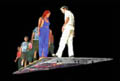
 One of the projects the jury of the category 'Interactive Art' has nominated for the Golden Nica is 'bump' by association.creation. This tactile installation – first implemented during Ars Electronica 99 – wants to counter the disembodiedness of network worlds.
Two wooden footbridges in public spaces – one in Linz, one in Budapest - ready to be the venue of mass public appearances. Every pressure produces an equivalent pressure that breaks through to the other side. There is a knocking below, the planks rise, power transmission via Internet—sensations on the move.
Tactile sensation as an elementary experience confers a feeling for distance and proximity. Fond regards or insults transmitted by media are mere trivialities in comparison to a tender embrace or a resounding slap in the face.
bump produces an irregularity in the urban interface, a position at which one no longer has firm ground under ones feet. A wooden grating on the asphalt—maybe an excavation? But now there is knocking from below and the boards rise up. Below is another city, reflecting the same irregularity, linked via data transmission line. What is going on there? Undifferentiated mass movements, a stampede of hundreds of feet at rush hour?
What about late at night: two or three pairs of feet. A perceptible rhythm, perhaps a message? Or just a game? We sense the illusion of proximity: directly below the board which raises itself up, we presume there is a force which approximates our own. But there is the apparatus, the piston arm, the control valve, the sensor. Closeness is only an illusion; distance is not abolished.
The thin spruce board is a wall hundreds of kilometers thick. Out of a casual encounter develops a lasting irritation of the sense of direction: west is below, below is east. How close can we get to one another?
In der Kategorie 'Interaktive Kunst' nominierte die Jury das Projekt 'bump' von association.creation für die Goldene Nica. Diese taktile Installation – erstmals implementiert während Ars Electronica 99 – versteht sich als Gegengewicht zur Körperlosigkeit der Netzwelten.
In den beiden in die Installation eingebundenen Städten – im konkreten Fall Linz und Budapest - ist jeweils ein 1,5 Meter breiter und 20 Meter langer Holzsteg auf einem öffentlichen Platz installiert. Betritt eine Person diesen Steg, löst sie durch ihr Eigengewicht einen Impuls aus, der mittels Datenleitung in die andere Stadt übertragen wird. Dort hebt ein pneumatischer Hubkolben das entsprechende Brett um Zentimeter.
Das Spüren als elementare Erfahrung (bump I: heftig stoßen, anprallen; bump into (fig.): jemanden zufällig treffen) gibt ein Gefühl für Entfernung und Nähe. Durch Medien übertragene Liebesgrüße oder Beschimpfungen sind nur eine Lächerlichkeit im Vergleich zu einer zärtlichen Umarmung oder einer schallenden Ohrfeige. bump erzeugt eine Unebenheit (bump II: Beule, Höcker) im städtischen Interface, eine Stelle, an der es keinen sicheren Boden unter den Füßen gibt. Ein Lattenrost auf dem Asphalt - vielleicht eine Baugrube? Da klopft es von unten, die Latten heben sich. Unten ist eine andere Stadt, spiegelbildlich dieselbe Unebenheit, angebunden über eine Datenleitung. Was spielt sich dort ab? Ein gleichgültiger Massen-Auftritt, Getrampel von Hunderten Füßen zur Stoßzeit? Dagegen spät nachts: zwei Paar, drei Paar Füße. Ein wahrnehmbarer Rhythmus. Vielleicht eine Botschaft? Oder nur ein Spiel? Wir empfinden die Illusion der Nähe: Direkt unter dem Brett, das sich hebt, vermuten wir eine Kraft, die der unseren gleicht. Aber dort ist der Apparat, der Hubkolben, das Steuerventil, der Sensor. Die Nähe ist nur Schein, die Distanz ist nicht aufgehoben. Das dünne Fichtenbrett ist eine Wand, Hunderte Kilometer dick (bump III: ~ of locality: Ortssinn). Aus der beiläufigen Begegnung wird eine bleibende Irritation des Ortsinns: Westen ist unten, unten ist Osten. Wie nah können wir einander kommen?

