
 From June 7 to June 17 a real and a virtual string are connecting Ars Electronica Center and C3 in Budapest. 'Global String' is a networked musical installation by the two musicians Atau Tanaka and Kaspar Toeplitz. They are using the Intenet as a resonant body for several interconnected steel strings in different locations. Visitors in various distant locations play together on the same virtual string. There will be two live performances: On June 7 in Budapest and on June 17 in Linz.
The concept is to create a musical string (like the string of a guitar or violin) that spans the world. Its resonance circles the globe, allowing musical communication and collaboration among the people at each site.
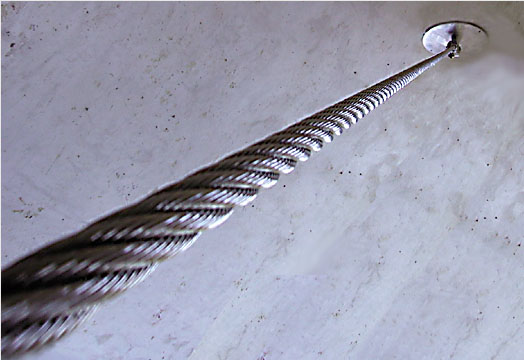
The installation 'Global String' consists of a real physical string connected to a virtual string on the network. The real string (12mm diameter, 15m length) stretches from the floor diagonally up to the ceiling of the space. On the floor is one end - the earth. Up above is the connection to the network, to one of the other ends somewhere else in the world. Vibration sensors translate the analog pulses to digital data. Users who are visually connected via video strike the string, making it vibrate.
Eine reale und eine virtuelle 'Saite' verbinden vom 7. bis 17. Juni das Ars Electronica Center mit C3 in Budapest. 'Global String' ist eine vernetzte Musikinstallation der beiden Musiker Atau Tanaka und Kaspar Toeplitz. Sie nutzen das Internet als Resonanzkörper, über den Spieler in Linz und Budapest gemeinsam auf derselben virtuellen Saite spielen können. Die Künstler selbst performen zwei Mal live: am 7. Juni in Budapest und am 17. Juni in Linz.
Bei 'Global String' geht es darum, eine weltumspannende Saite (wie die Saite einer Gitarre oder Geige) zu schaffen. Die Schwingungen dieser Saite ermöglichen eine musikalische Kommunikation und ein Zusammenspielen von Menschen an den verschiedenen Locations auf der ganzen Welt.
Die Installation selbst besteht aus einer realen Saite, die mit der virtuellen Saite im Netzwerk verbunden ist. Die echte Saite (12 Millimeter im Durchmesser, 15 Meter lang) ist zwischen Boden und Decke gespannt. Der Boden entspricht dem einen Ende, der Erde. An der Decke befindet sich die Verbindung zum Netzwerk, zu einem der anderen Enden irgendwo auf der Welt. Vibrationssensoren übersetzen die analogen Schwingungen in digitale Daten. Die Mitspieler, die via Video visuell miteinander verbunden sind, können, versetzen durch ihre Berührung die Saite in Schwingung.

