|
----- 1999 ------
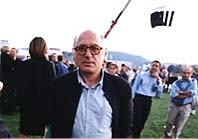
Twenty years ago at the first Ars Electronica, the idea of the Linzer
Klangwolke was also born. And to this day, it has remained an important
and successful element in the effort to develop new, innovative forms
for art in public spaces. This year, in collaboration with the Brucknerhaus
and the ORF, Ars Electronica is launching an experiment to try out promising
forms of this approach and to deal with altered forms of public spaces
and the public sphere. The confrontation with the Danube as a cultural
environment and as a political field of tension and interplay of forces
will be formulated as an artistic challenge. This year, the invitation
has been extended to the English composer Michael Nyman together with
artists Robert Worby, Fadi Dorninger, Robin Rimbaud aka Scanner, Sam
Auinger, Rupert Huber, Gordan Paunovic, Joachim Schnaitter, Markus Decker
and Hubert Hawel. Nyman’s style is primarily based upon employing
music of prior epochs as a compositional resource. In Klangpark, his
multifaceted body of work and the practice of his musical theory which
anticipated what would later become sampling will come together with
digital music.
----- 2000 -----
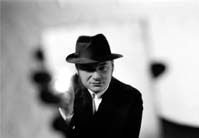
A concert launches the exploratory artistic journey of Klangpark 2000.
New interpretations and reformulations of songs of the legendary Romanian
singer Maria Tanase are the point of departure announced by internationally
renowned composer and violinist Alexander Balanescu. Featuring an ensemble
that includes Isabella Bordoni, Rupert Huber, Sergio Messina, Siegfried
Ganhör and To Rococo Rot, the exploration of divergent musical
styles and modes of performance will take center stage. Listeners can
expect to experience a totally unique tonal atmosphere, which the Donaupark
charges with cultural symbolism, engendering a sensorially stunning
acoustic space.
This concert marks the beginning of a 57-hour live soundtrack that will
be accompanied by daily performances.
----- 2001 -----
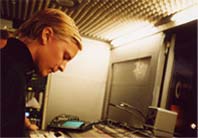
Music for a river and for passers-by — Klangpark 2001 transforms
the park on the banks of the Danube into an impressive acoustic environment.
With his electronic sound designs developed especially for this occasion,
the young Scandinavian musician Vladislav
Delay once again puts his fascinating digital mode of musicality
on display. His tonal stylings initially seem diametrical. Only the
key signatures have something in common: reduction, abstraction, transcoding.
The persuasive distinctions of his various sound-aesthetic personae
have made the electronic autodidact and ex-drummer a regular fixture
in the much-sifted-through no-man’s-land at the nexus of electronica,
dub and house.
|